BitPangea: Origins
The complete record of the architectural reasoning that established the World: one finite, complete, continuous cartographic whole containing exactly 21,000,000 Parcels.
Publication Status
BitPangea: Origins — Version 0.1, The Foundational Manuscript of a Finite Digital World, preserves the architectural reasoning through which BitPangea’s present understanding emerged as of September 2026.
Origins is not a final technical specification and does not imply that every explored design has been adopted. It preserves the reasoning path, distinctions, corrections, dependencies, open questions, and architectural commitments that established the World. Future versions may continue that record while Version 0.1 remains preserved as a permanent historical publication.
Origins and the Record
Origins serves a different purpose from BitPangea’s other principal records. It is the foundational manuscript: the place where the reasoning itself is preserved rather than reduced only to current conclusions.
Abstract
BitPangea asks what becomes possible when a digital world is designed as a World first.
Rather than beginning with applications, markets, ownership, social systems, or predefined experiences, BitPangea begins with the deeper conditions required for persistent digital place.
What must be true of a digital place before it can meaningfully become a World?
Its developing answer begins with one finite, complete, continuous cartographic World containing exactly 21,000,000 Parcels. Beneath visible geography and experience lies a survey-first spatial architecture intended to preserve canonical location, persistent Parcel identity, and continuity across changing technology, representation, rights, use, and civilization.
The clearest demonstrated spatial dependency is:
Origins records how these distinctions emerged, why responsibilities were separated, where terminology and architecture were corrected, which ideas became established, which remained provisional, and which questions were deliberately left unresolved.
The manuscript also preserves a governing asymmetry: the deeper the system lies within the definition of the World, the greater its expected permanence; the closer it lies to Builders, participants, culture, and experience, the greater its freedom to evolve.
The Creator’s responsibility is not to predetermine civilization. It is to establish enough World that civilization can meaningfully occur.
Origins is therefore not merely a history of design decisions. It is the preserved record of the architectural reasoning that established BitPangea’s present World.
Origins Contents
Version 0.1 is presented as nineteen linked chapters. Each chapter page is a web presentation of the preserved manuscript and should be read within the context of the complete versioned work.
Abstract
The foundational question, one finite World, exactly 21,000,000 Parcels, survey-first architecture, persistent place, and deliberate restraint.
The Premise
The World-first proposition: establish the World before attempting to create the civilization that may eventually inhabit it.
The World
BitPangea as one finite, complete, continuous cartographic whole, with one World, one underlying spatial truth, and many valid representations.
Finitude and The Extent
Why BitPangea is finite, how The Extent carries complete spatial scope, and why Finitude does not require an Edge, Exterior, or conventional terminal form.
The 21,000,000 Parcel Constraint
How a fixed spatial supply becomes an architectural obligation and why exactly 21,000,000 Parcels must be reconciled to one finite World.
World Form
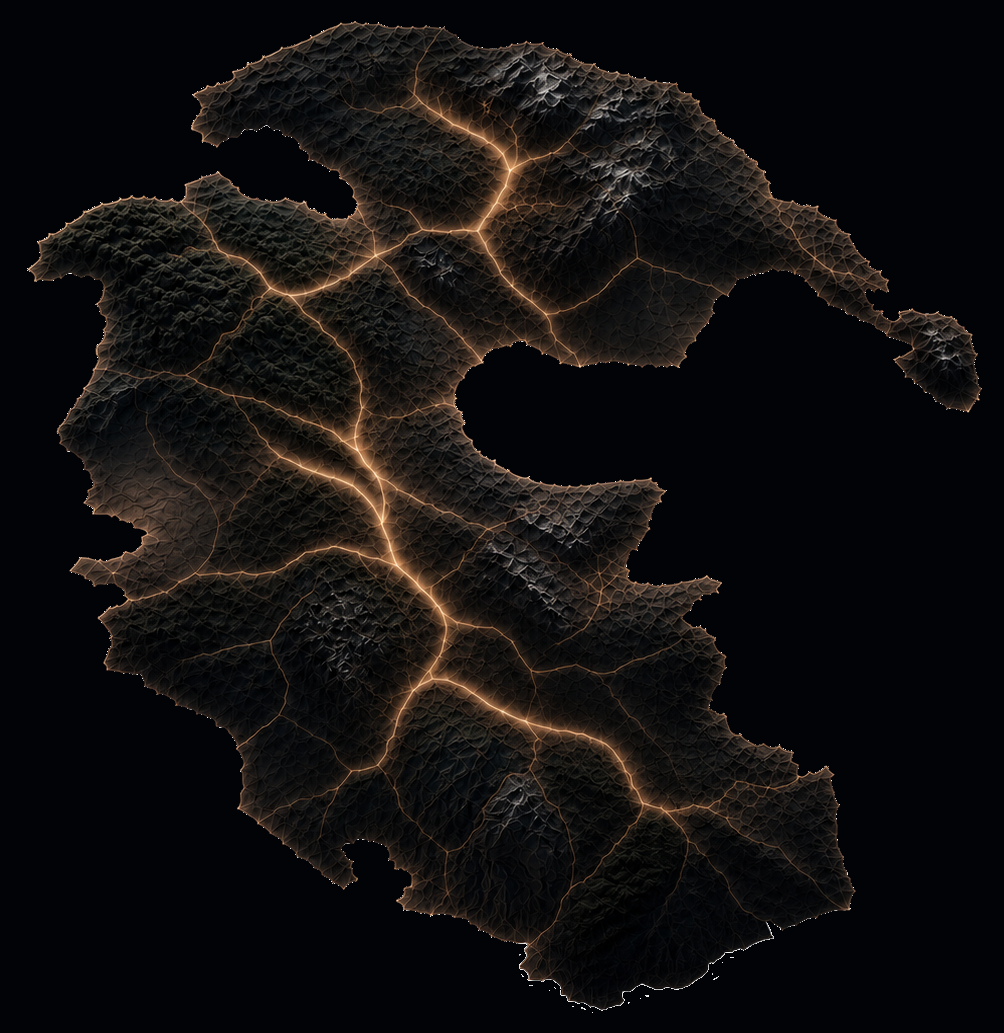
The singular, compositionally balanced, asymmetric digital supercontinent: organic in macro-form, digital in substance, and composed of connectivity.
Foundational Survey Fabric
The minimal, exact, finite, planar, semantically neutral canonical spatial reference architecture beneath higher World systems.
Parcel Geometry and Cadastre
The distinction between spatial form and cadastral authority, persistent Parcel identity, fixed position, equal-area direction, and the leading rhombille grammar.
The Architecture
The nine recognized Architecture domains, their responsibility boundaries, demonstrated dependencies, permanence gradient, and separation of membership from ordering.
Identity, Rights, and Control
The distinctions among actor identity, governed relationships, ownership, authorization, exercisable authority, and legitimate action.
World Runtime
The operational architecture through which BitPangea can evaluate legitimate change, execute permitted operations, preserve World State, and continue coherently through time.
Builders and Civilization
How creation extends beyond the Creator, why Builders operate above the Architecture, and why civilization must remain capable of emergence.
History, Memory, and Digital Antiquity
How persistence becomes memory and history, how Digital Antiquity is inherited, and how BitPangea may eventually acquire antiquity of its own.
Constitutional Architecture
The discipline for deciding what deserves permanence, how status and authority are separated, and why canon must be earned rather than accumulated.
What Is Established
A consolidated record of the World truths, architectural commitments, distinctions, and design directions strong enough to constrain later work.
What Remains Open
A disciplined record of unresolved, dependent, parked, and intentionally open questions across spatial, operational, civilizational, and constitutional architecture.
Development Philosophy
The working discipline behind BitPangea: requirement before technology, dependency before schedule, prototype freedom, constitutional economy, and durable meaning above replaceable implementation.
The Path Forward
The architectural path ahead: resolve deeper dependencies, prove the Parcel architecture, mature the Runtime and authority systems, enable Builders, and preserve civilization’s freedom to emerge.
Conclusion — A World Before a Civilization
The manuscript’s thesis distilled: place before asset, architecture before economy, persistence before history, precision below, freedom above, and one World capable of many futures.
Publication Files
Version 0.1 is preserved in multiple formats for reading, citation, archival access, and technical reuse.

BitPangea: Origins
The Foundational Manuscript of a Finite Digital World.
The complete record of the architectural reasoning that established the World.