The
Principles
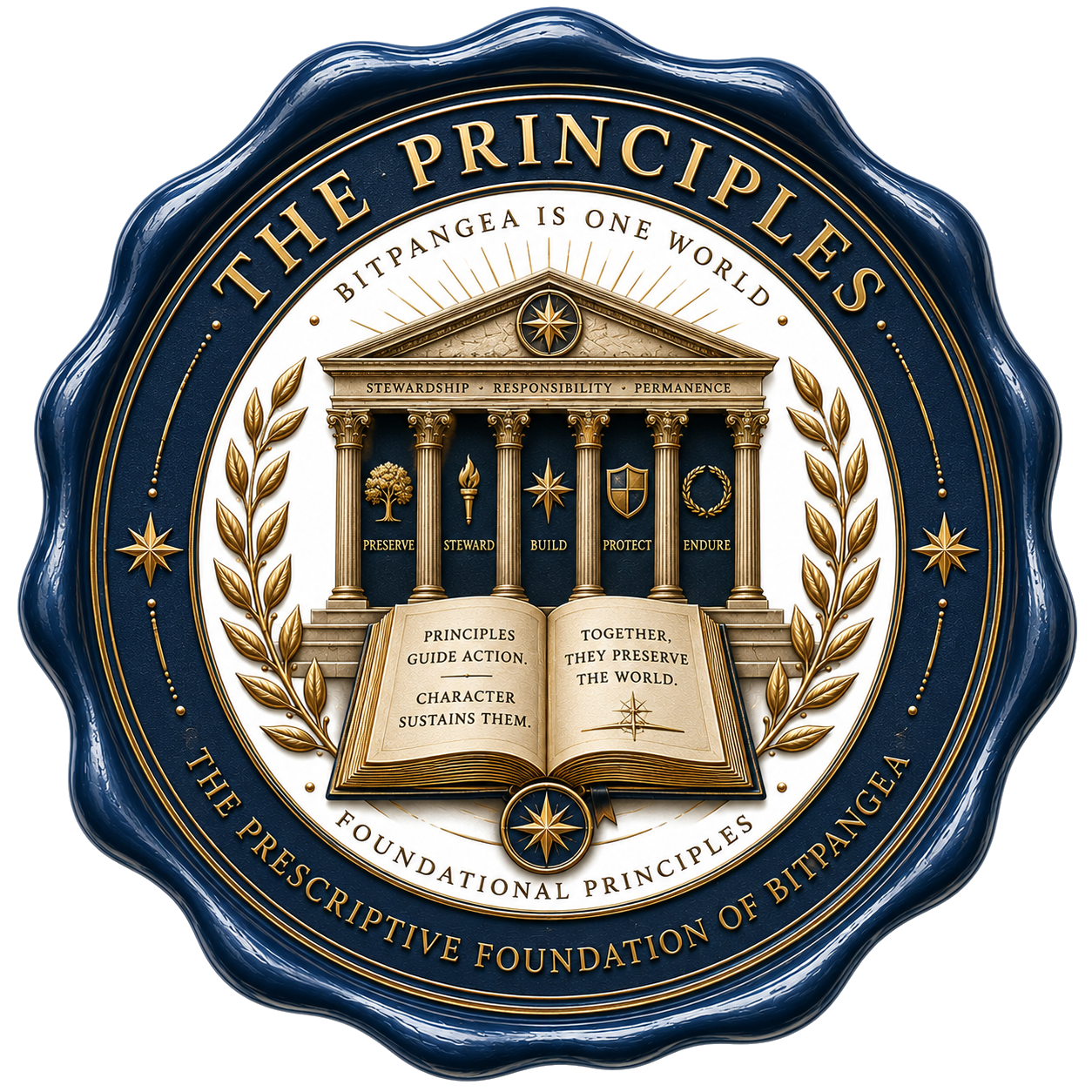
The Principles preserve how BitPangea should be approached. They do not state what is unconditionally true; they guide the conduct, restraint, care, and stewardship expected of those who encounter the world.
Truths describe what is. Principles guide what should be. Maxims preserve what should be remembered.
Purpose
The Principles are not Codex definitions and they are not the Codex Principles. The Codex Principles preserve lessons revealed through formal Codex inquiry. The Principles belong to The Foundation and preserve a broader stewardship doctrine for the world as a whole.
Where The Truths are descriptive, The Principles are prescriptive. They ask how a finite world should be handled, recorded, explored, built upon, and carried forward without reducing stewardship to ownership or discovery to possession.
I · Stewardship
Preserve before you possess.
A world should be approached first as something to be cared for, not merely as something to be held.
Stewardship surpasses ownership.
Ownership may describe control; stewardship describes responsibility.
Receive the world with restraint.
A finite world should not be rushed, exhausted, or treated as disposable.
Leave more understanding than you found.
Every act within the world should make the world more intelligible to those who follow.
II · Record
Preserve the record.
What is discovered, decided, revised, or questioned should be preserved with care.
Do not erase the path.
Earlier forms, discarded ideas, and historical records help future builders understand how the world became known.
Distinguish record from invention.
The record should preserve what happened without pretending that preservation creates the past.
Let memory serve continuity.
A world endures more faithfully when its memory is carried forward rather than repeatedly reconstructed.
III · Discovery
Discover without claiming creation.
To reveal part of the world is not to author the world itself.
Honor the frontier.
The unknown should be approached with patience, humility, and care.
Map faithfully.
The map should follow the world rather than force the world to fit the map.
Let knowledge remain revisable.
Understanding may improve without requiring the world to change.
IV · Relation
Recognize relation.
No place should be understood entirely apart from what surrounds it.
Build from connection, not isolation.
Higher structures should respect the relations that give places context.
Let distinction remain humane.
Boundaries may clarify without becoming instruments of needless division.
V · Construction
Build only upon what has been understood.
Civilizational structures should not outrun the foundations that make them coherent.
Do not confuse speed with permanence.
What is built quickly may not endure; what endures requires care.
Let institutions earn their place.
No institution should be established before the world naturally requires it.
VI · Inheritance
The future is a stakeholder.
No generation should treat itself as the final steward of the world.
Inheritance is responsibility.
The greatest gift is not possession of the world, but the obligation to preserve it faithfully.
Carry the world forward.
What is received should be preserved, clarified, and handed onward with greater understanding.
What The Principles Are Not
The Principles are not the constitutional realities of BitPangea. Those belong to The Truths. They are not cultural sayings or distilled wisdom. Those belong to The Maxims. They are not the domain-specific lessons of adopted Codices. Those remain within the Codex Principles.
The Principles are the stewardship doctrine of The Foundation: a guide for how the world should be approached before future civilizational governance exists.